
- Data Basin |
- Datasets |
- San Joaquin Valley - Agricultural Land Quality (Final 2018)
San Joaquin Valley - Agricultural Land Quality (Final 2018)
Jun 15, 2018
(Last modified Jun 20, 2018)
Uploaded by
Conservation Biology Institute
- Description:
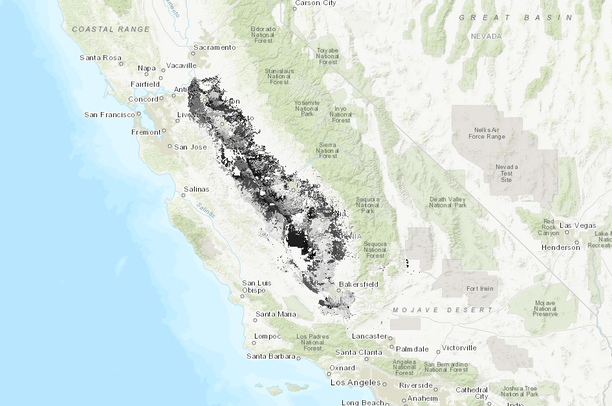
- Model showing the relative agricultural land quality across the San Joaquin Valley. See the attachment for more detailed information.
Extracted from Land Water Intersection Report:Our first inquiry addressed the intrinsic quality or agricultural resource value of the land in the Valley. The focus was on characteristics that are inherent in the land and soil itself and, as such, are extremely difficult to improve or overcome by human intervention. Our assumption was that, all else being equal, land with more favorable intrinsic characteristics is more likely to be productive, versatile, sustainable, and profitable for agriculture. Thus, we sought to identify and integrate spatial data that reflected both positive and negative attributes to define relative agricultural land quality in the Valley.
The datasets representing positive attributes included:
• California Storie Index (a formal measure of soil productivity for agricultural uses)
• Farmland Mapping & Monitoring Program (FMMP) rank categories (reflecting soil productivity and active irrigation)
• Aquifer recharge potential (Soil Agricultural Groundwater Banking Index - a direct link between land and the availability of water)
• Microclimate (particularly for high value citrus production)
These data were processed for just over six million acres on the Valley floor using 270-meter resolution with each reporting unit equivalent to roughly 18 acres. Areas were identified as having active agricultural land if they contained any known crop production as determined by the California Department of Conservation through the Farmland Mapping & Monitoring Program, a biennial aerial survey of agricultural land throughout California.
We took the same approach in combining datasets representing negative attributes of the land, including:
• Soil salinity and sodicity (which limit productivity and what can be grown on the land)
• Shallow groundwater tables (also a limitation on production due to restricted root development and health)
• Pattern of recent (2011-2016) fallowing (reflecting economic decisions based on land or water limitations during the recent drought)
Within the EEMS modeling environment, the positive attribute data were combined to produce an index of land asset value and the negative attribute data were combined to produce an index of land impairment value. All datasets used to form the individual indexes were given equal weight – though alternative weighting would be possible – and normalized to fit on the same scale (-1 to +1) in order to combine and assess varying input data . While valuable individually, the combination of these two indices produced a superior overall Land Quality score (Figure 1). The Land Quality scores for all locations throughout the Valley were then grouped into high, medium, or low ranges using a mathematical algorithm called the Jenks Natural Breaks method. This approach identifies natural breaks – like stair steps – in the data by maximizing similarity and differences between groups, allowing for a simple and unbiased grouping process.
- Data Provided By:
- Dustin Pearce, CBI
- Content date:
- not specified
- Contact Organization:
- not specified
- Contact Person(s):
 Dustin Pearce
- Use Constraints:
 This work is licensed under a Creative Commons Attribution 3.0 License.
- Layer:
- Layer Type:
- Currently Visible Layer:
- All Layer Options:
- Layers in this dataset are based on combinations of the following options. You may choose from these options to select a specific layer on the map page.
- Description:
- Spatial Resolution:
- Credits:
- Citation:
- Purpose:
- Methods:
- References:
- Other Information:
- Time Period:
- Layer Accuracy:
- Attribute Accuracy:
FGDC Standard Metadata XML
Click here to see the full FGDC XML file that was created in Data Basin for this layer.
Original Metadata XML
Click here to see the full XML file that was originally uploaded with this layer.
This dataset is visible to everyone
- Dataset Type:
-
NetCDF File
- Capabilities:
-
Includes Environmental Evaluation Modeling System Logic model
Downloaded by
15 Members
Bookmarked by
2 Members
,
1 Group
Included in
18 Public Maps
,
281 Private Maps
Included in
3 Public Galleries
,
1 Private Gallery
About the Uploader

Conservation Biology Institute
We provide advanced conservation science, technology, and planning to empower our partners in solving the world’s critical ecological challenges
